Autism Symptoms Checklist
If you are concerned about your child’s development, downloading and reviewing an autism symptoms checklist can be a helpful first step. A printable checklist allows parents, caregivers, and educators to become more familiar with early warning signs of Autism Spectrum Disorder (ASD) and to decide whether a professional evaluation may be needed. While noticing possible symptoms can be emotionally difficult, identifying concerns as early as possible gives children the best opportunity to receive support and build essential life skills.
Autism Spectrum Disorder is a neurodevelopmental condition that affects communication, social interaction, behavior, and sensory processing. The term “spectrum” reflects the wide range of strengths and challenges that individuals with autism may experience. Some children show signs very early in toddlerhood, while others may not display noticeable symptoms until preschool or later childhood.
An autism symptoms checklist is not a diagnostic tool, but it can provide valuable guidance and help parents organize their observations before speaking with a pediatrician, psychologist, or developmental specialist.
Why Early Identification Matters
Suspecting that your child may be on the autism spectrum is never easy. Many parents experience worry, confusion, or even denial at first. However, ignoring potential signs will not make them disappear. In many cases, delays in communication, social interaction, or adaptive behavior may become more noticeable over time.
Research consistently shows that early intervention significantly improves long-term outcomes for children with Autism Spectrum Disorder. When therapy begins during the toddler or preschool years—when the brain is most adaptable—children often make meaningful gains in language, social skills, and daily functioning.
Using an autism symptoms checklist early allows families to take action sooner rather than later.
Updated Diagnostic Criteria: DSM-5 and DSM-5-TR
Older checklists were based on the DSM-IV, which separated autism into multiple diagnoses such as autistic disorder, Asperger’s syndrome, and pervasive developmental disorder–not otherwise specified (PDD-NOS). These categories are no longer used.
The DSM-5 and its updated text revision, DSM-5-TR, now classify these conditions under a single diagnosis: Autism Spectrum Disorder (ASD). This change reflects a more accurate understanding of autism as a spectrum with varying levels of support needs rather than separate disorders.
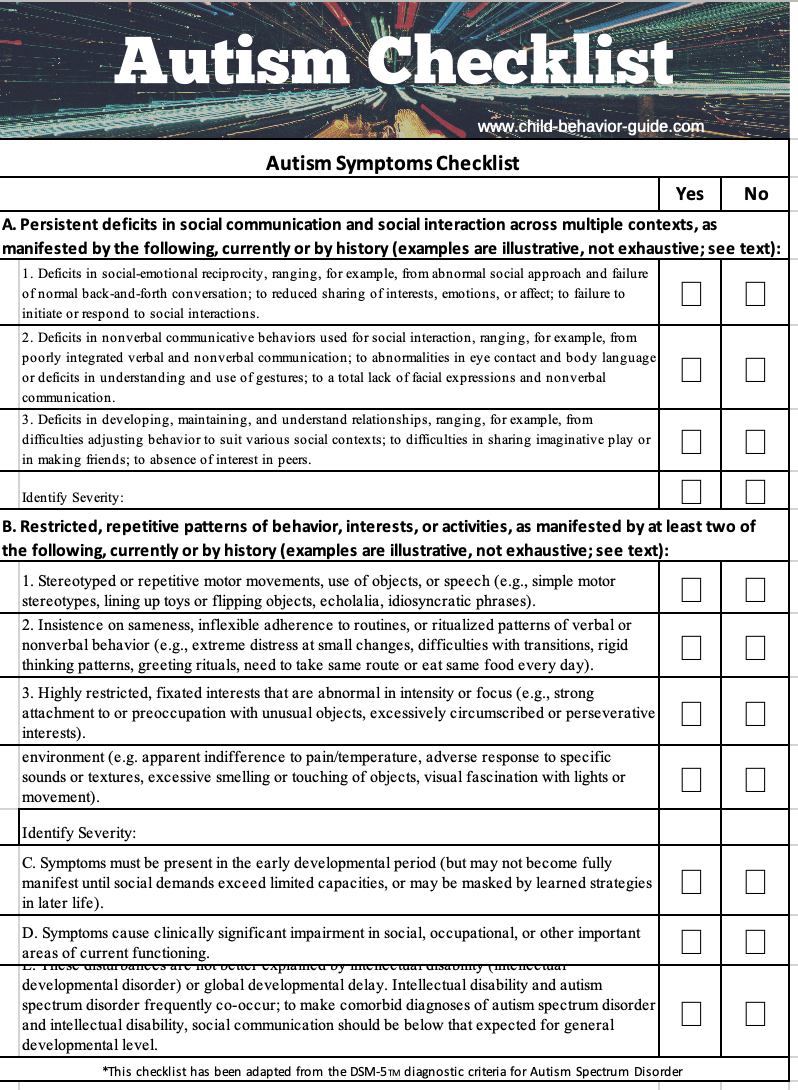
Under the DSM-5-TR, autism is diagnosed based on two primary domains:1. Persistent Differences in Social Communication and Social Interaction
These may include:2. Restricted and Repetitive Patterns of Behavior, Interests, or Activities
- Limited eye contact or facial expressions
- Difficulty engaging in back-and-forth conversation
- Reduced sharing of interests or emotions
- Challenges forming or maintaining relationships
- Difficulty understanding social cues, body language, or tone of voice
Examples include:
- Repetitive movements (hand flapping, rocking, spinning)
- Strong preference for routines or resistance to change
- Highly focused or intense interests
- Repetitive speech or echolalia
- Sensory sensitivities (over- or under-reacting to sounds, textures, lights, or smells)
A modern autism symptoms checklist reflects these DSM-5-TR criteria rather than outdated DSM-IV language.
Autism Symptoms Checklist for Toddlers
Early signs of autism often appear between 12 and 24 months, though they may be subtle. A toddler-focused autism symptoms checklist may include questions such as:
- Does your child respond to their name consistently?
- Does your child use gestures like pointing or waving?
- Is there limited eye contact during play or interaction?
- Does your child engage in pretend play?
- Are there delays in speech or loss of previously learned words?
- Does your child show repetitive behaviors or unusual attachment to objects?
- Does your child seem overly sensitive to noise, touch, or textures?
Toddlers may also show limited interest in social games like peek-a-boo, have difficulty imitating others, or prefer playing alone most of the time.

You will need Adobe Reader (the latest version is recommended) installed on your computer in order to open and print an autism symptoms checklist. You can get Adobe Reader here (a new window will open so you can download it without leaving this page, but you will need to temporarily disable any pop up blockers to open the new window).
If you want to open the file in your browser window, just click on the image. However, if you want to download the file to view later, then right-click on the link and choose "Save Target As" or "Save File As." Then select where you want to save the file on your hard drive.
Once you have saved the file, locate where you saved it, and double click to open.
In order to print, open the downloaded file, and select the "Print" option.
Autism Symptoms Checklist for Older Children
Some children, especially those with average or above-average intelligence, may not be identified until later childhood. These children may speak well but still struggle with social communication. An autism symptoms checklist for older children may include:
- Difficulty understanding social rules or peer relationships
- Literal interpretation of language or trouble understanding humor
- One-sided conversations focused on specific interests
- Trouble with transitions or unexpected changes
- Anxiety related to sensory overload or social situations
- Emotional regulation difficulties or frequent meltdowns
Children previously described as having Asperger’s syndrome are now considered part of Autism Spectrum Disorder under DSM-5-TR, often requiring lower levels of support but still benefiting greatly from appropriate services.
Treatment and Early Intervention Options
Once concerns are identified through an autism symptoms checklist and confirmed by a professional evaluation, early intervention can begin. Common evidence-based supports include:
Applied Behavior Analysis (ABA)
ABA therapy focuses on improving communication, social, and adaptive skills using structured, individualized techniques. When provided by a trained and certified ABA therapist, it is one of the most widely researched and effective interventions for autism.
Speech and Language Therapy
Speech therapy can help children develop expressive language, improve understanding, and enhance social communication skills.
Occupational Therapy
Occupational therapy is especially helpful for children with sensory processing challenges, fine motor delays, or difficulties with daily living skills.
Developmental and Behavioral Supports
Other approaches may include social skills groups, parent training programs, and school-based accommodations. Some families also explore complementary or biomedical treatments. These should always be discussed with qualified healthcare professionals to ensure safety and effectiveness.
Important Reminder About Checklists
An autism symptoms checklist cannot diagnose autism. Only a qualified professional can make a diagnosis using standardized assessments, clinical observation, and developmental history. However, checklists are extremely useful for:
- Tracking behaviors over time
- Organizing concerns
- Communicating clearly with healthcare providers
- Deciding whether a formal evaluation is warranted
Parents are encouraged to bring completed checklists to pediatric appointments or developmental assessments.
You may also find the following chart related to asperger syndrome behavior to be helpful for an older child that is communicating fairly well. Although, this is no longer a recognized diagnosis and all symptoms now are under the umbrella of autism, it may still be a good reference in helping identify older kids that may have autism, but have less severe symptoms.

Final Thoughts
Recognizing early signs of Autism Spectrum Disorder can feel overwhelming, but knowledge is empowering. An updated, DSM-5-based autism symptoms checklist provides a practical and supportive starting point for families seeking answers. The sooner concerns are identified, the sooner children can access the tools, therapies, and support they need to thrive.
If you have concerns, trust your instincts, use a checklist, and seek professional guidance. Early action can make a meaningful difference in your child’s development and quality of life.
If you haven't already, be sure to check out my ebooks, now on Amazon!
 |
 |
References
1. American Psychiatric Association. (2000). Pervasive Developmental Disorders In Diagnostic and statistical manual of mental disorders (Fourth edition---text revision (DSM-IV-TR). Washington, DC: American Psychiatric Association, 70-75.
2. Baron-Cohen, S. et. al. (1992) "Can autism be detected at 18 months? The needle, the haystack, and the CHAT," The British Journal of Psychiatry, 161, pp. 839-843.